 MovieSequelHub
Since its June 20, 2025 release, KPop Demon Hunters has evolved from a standalone animated sensation into a sprawling speculative universe. The 96-minute Netflix film follows HUNTR/X—Rumi, Mira, and Zoey—a chart-topping pop trio that moonlights as a demon-slaying unit. By 2026, with no sequel officially confirmed but persistent chatter about a prequel series, an animated follow-up, or even a live-action adaptation, fans have turned the movie’s dense lore into a mosaic of theories. The fandom now behaves like a constellation trying to fold itself into a single star, pulling together Korean mythology, real-world K-pop history, and Abrahamic cosmology in hopes of predicting what comes next.
The Power of Three—and the Coming Fourth Member
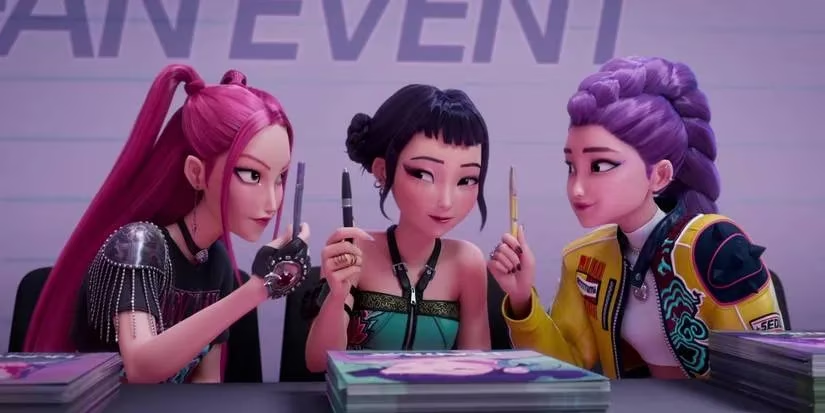
KPop Demon Hunters establishes that musical trios have protected humanity for decades, a lineage that reaches HUNTR/X. The dissolution of Celine’s group after Mi-yeong’s death implies a strict rule: only three Hunters can exist at once. This emphasis on trios is a clear nod to real K-pop history. The Kim Sisters, S.E.S., and The Hee Sisters were prototypical idol groups, all consisting of three members, and the film’s opening montage of historical Hunter trios reads as a direct homage.
Yet the new Honmoon at the end of the film may soon challenge that convention. Just as real idol groups evolved beyond the rigid three-member format, HUNTR/X could expand its ranks. A hypothetical fourth member could also embody K-pop’s continued global popularity, perhaps inspiring non-Korean artists. Zoey is technically half-American, but a new recruit could be another nationality entirely, representing the modern growth of K-pop as a worldwide phenomenon.
Four Symbols Theory: HUNTR/X as Mythic Guardians
Korean mythology offers another reason to expect a quartet. The Four Symbols—also called the Four Guardians, Four Gods, or Four Auspicious Beasts—are represented by a color, an animal, and a cardinal direction. Fans have noticed striking parallels between HUNTR/X and these guardians.
| Guardian | Direction | Color | Animal | HUNTR/X Parallel |
|---|---|---|---|---|
| Azure Dragon | East | Azure/turquoise | Dragon | Zoey, who wears turquoise and fights with fanning knives like dragon claws |
| Vermilion Bird | South | Red-orange | Bird | Missing fourth member, likely with fiery plumage or weaponry |
| White Tiger | West | White | Tiger | Rumi, who wears white and bears tiger-like markings |
| Black Tortoise | North | Black | Tortoise | Mira, who wears black, has long hair, and wears shoulder pads or a sleeping bag |
Only the Vermilion Bird of the South is missing. Whoever joins HUNTR/X may wear bright orange-red and sport elaborate plumage-like hair or fiery weapons. Real-world evidence strengthens the idea: Blackpink, whose music influenced the film’s soundtrack, promoted How You Like That with outfits loosely correlating to the Four Guardians. Lisa represented the Vermilion Bird. Lisa also broke K-pop conventions as Blackpink’s first non-Korean member, originally from Thailand. That suggests HUNTR/X’s fourth member may be a non-Korean idol representing the final guardian.
Rumi’s Blood: Demon, Celestial, or Something Else?
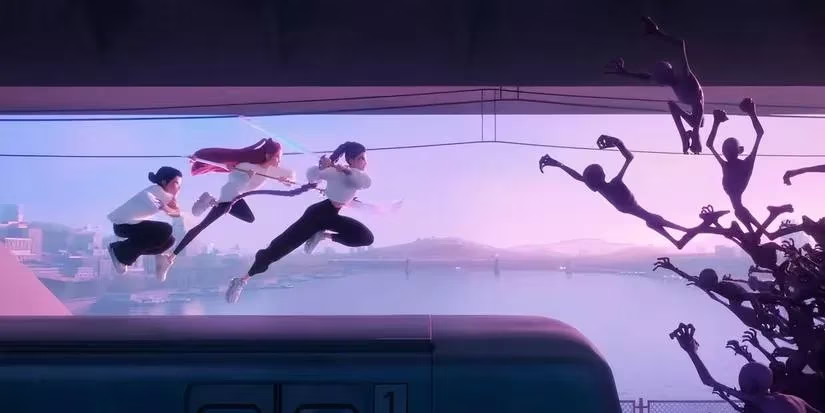
Much of the film’s conflict stems from Rumi’s secret half-demon heritage, which she only embraces and reveals at the emotional climax. Her demonic new form is shocking, but some fans argue her markings are not demonic at all. Despite being half-demon from birth, Rumi is never shown hearing Gwi-Ma’s whispering influence. That detail matters because Gwi-Ma is not based on any discernible Sino-Korean folklore. He is closer to an amalgamation of the Western concept of an ultimate underworld ruler, a Satan or Lucifer figure.
If Gwi-Ma has a demonic counterpart, the world may also contain an all-powerful heavenly good deity. Rumi’s heritage could then be half-celestial rather than half-demonic, with parentage from a divine influence. This would explain her seeming immunity to Gwi-Ma’s corruption. Like a court scribe translating a thunderstorm into footnotes, the theory turns a small omission into a cosmic clue.
Jinu’s Afterlife and the Bureaucracy of Korean Myth
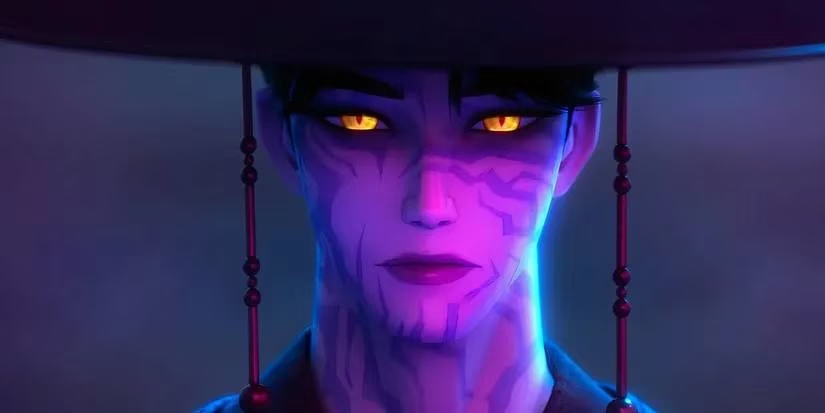
Jinu’s possible return has inspired fierce speculation because of his popularity as a romantic interest and foil to Rumi. Korean folklore may justify hope. In Korean mythology, the afterlife is a bureaucratic nightmare, with countless souls managed for overcrowding and only a few granted reincarnation. When Jinu dies, his soul is seemingly absorbed into Rumi’s sword, whose blade is decorated with a constellation motif. That may be more than decoration. Having lived a complicated life, Jinu’s final selfless act could have been enough to grant him entry into the celestial side of the afterlife, ready to be judged for reincarnation.
The Saja Boys and Dr. Han’s Faustian Bargains
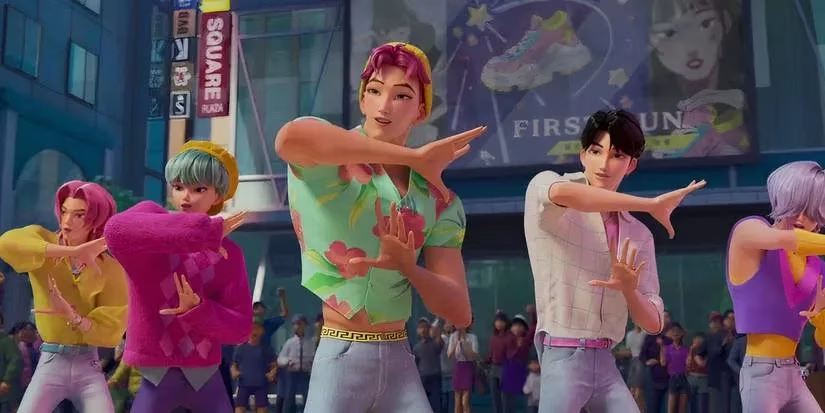
The rest of the Saja Boys are neglected by the plot. Little is known about their earlier lives, and whether they were once human like Jinu or demons from birth is unclear. A small background detail implies the former. During the scene in Dr. Han’s office, a photograph shows four young men, seemingly an idol group. One theory claims this is the Saja Boys sans Jinu before they made it big.
According to the theory, Dr. Han secretly works for Gwi-Ma, finding vulnerable idols to strike Faustian bargains with. He may have cursed the once-human Saja Boys into becoming demons. Their personalities could reflect the issues they had as humans. Mystery may have been doxxed, and his bargain included a wish for privacy that forced him into an enigmatic, featureless persona. Baby may have been overly sexualized by fans, leading to his infantilization. Abby may have suffered from envy and body dysmorphia, resulting in a stunning physical transformation. Romance may have been aloof and socially distant, meaning his wish may have been for charisma to win fans’ hearts. Each Saja Boy may have struck a cursed deal with Gwi-Ma in exchange for becoming a demonic figurehead.
What These Theories Mean for a Sequel
As 2026 unfolds, the mystery of the non-Jinu Saja Boys remains one of the most hotly anticipated areas for a sequel or prequel. The Four Symbols pattern, Rumi’s possible celestial blood, and Jinu’s soul in a constellation-marked sword all point toward a larger cosmology. None of these theories is confirmed, but together they show why KPop Demon Hunters has become a rare original animated property with the gravitational pull of a franchise. The film’s lore combines theological shards, pop history, and character secrets, and fans are sorting through every piece. If a sequel does arrive, it will be scrutinized like a prophecy hidden inside a pop chorus. Until then, HUNTR/X’s next chapter exists in the space between a new Honmoon and a fan’s wildest theory.